A therapy can clear every scientific hurdle; strong trial data, FDA approval, a clinician who believes in it, and still never reach the patient it was created for. That distance, between a drug that works and a patient who receives it, is where market access barriers live. In pharma, these obstacles slowly build across the journey from a prescriber’s intent to a therapy administered, and by the time they surface in the numbers, they are easy to mistake for underperformance.
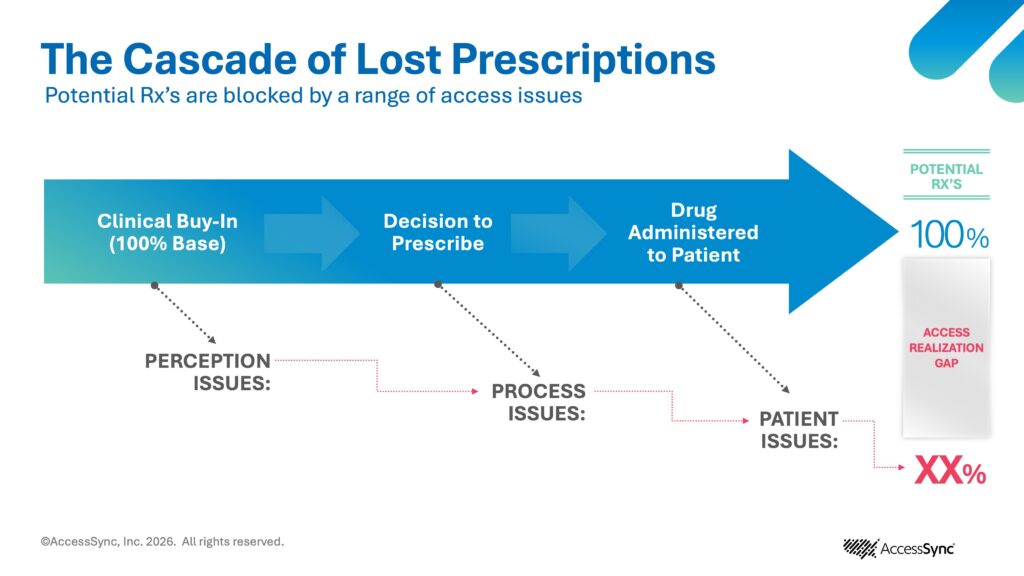
Understanding market access challenges in pharma means learning to see that accumulation clearly. We find it helps to group the obstacles into three layers, each occurring at a different point in the patient journey. Together, they make up what we call the Access Realization Gap: the compounding leakage between clinical buy-in and a drug administered to a patient.
The Three Layers of Market Access Barriers
Most market access strategy addresses one touchpoint at a time: a copay program here, a prior authorization workaround there. The barriers, though, operate as a chain. A brand can hold solid formulary coverage and still lose patients three links downstream. Seeing all three layers at once is what separates a strategy that closes the gap from one that optimizes individual pieces of it.
Perception Barriers: Before the Prescription Is Written
The first layer forms in the exam room, before anything reaches a pharmacy. A prescriber weighs whether a therapy is worth the potential friction.
Coverage uncertainty at the point of care. When a physician can’t quickly confirm whether a patient’s plan covers a therapy, hesitation is the rational response. Out-dated or hard-to-find coverage information removes confidence in clinical decisions.
Prior authorization fatigue. Prescribers who expect a documentation challenge frequently reach for a familiar, easier-to-approve alternative. The barrier here is a prescription that never gets written.
Affordability anxiety. A clinician who anticipates that a patient can’t afford the out-of-pocket cost may steer away preemptively, even when assistance exists that neither party knows about.
Perception barriers are the hardest to measure because they leave no paper trail. Nothing was denied or abandoned and yet the therapy simply wasn’t chosen.
Process Barriers: After the Prescription, Before the Patient
The second layer intercepts the prescription once it exists. This is the most visible set of market access barriers in pharma, and the most quantified.
Prior authorization delays and denials. PA remains the dominant chokepoint for specialty and other high-cost branded therapies. A 2026 JAMA Health Forum analysis of 205,896 branded prescriptions initially rejected by prior authorization found that only 35 percent were resolved on the first day, and just 7 percent were approved on the day of the patient’s first fill attempt. For prescriptions not settled that day, the final decision took a median of six days and only 54 percent were ever approved.1
Benefit verification friction. Confirming coverage, tier placement, and patient responsibility can take days that a patient in pain or crisis does not have.
Step therapy and utilization management. Payers increasingly require patients to fail another option first. Each required step is another opportunity for the prescription to stall.
Specialty pharmacy routing. Triage and transfer between the prescriber, the hub, and a specialty pharmacy introduce handoffs, and every handoff is a place for a therapy to fall out of the process.
Patient Barriers: After Initiation
The third layer is the most difficult, because it appears after everything has apparently gone right. Coverage was secured. The therapy was dispensed. And the patient still doesn’t stay on treatment.
Cost at the counter. Prescription abandonment climbs sharply with out-of-pocket cost. A patient who reaches the pharmacy and sees the price can walk away from a therapy that took weeks to authorize.
Coverage instability. Policy shifts may move patients on and off coverage with less notice. Medicaid redetermination churn and the coverage changes flowing from the One Big Beautiful Bill Act (OBBBA) are already showing up as gaps in continuity; patients who were covered when treatment began and aren’t a few months later.
Adherence and care coordination gaps. Complex titration schedules, missed refills, and enrollment paperwork for copay assistance all erode persistence over time.
Why These Barriers Compound
The reason market access challenges in pharma are so persistent is that they multiply rather than add. A brand that clears 80 percent of perception barriers, 80 percent of process barriers, and 80 percent of patient barriers hasn’t retained 80 percent of its potential patients, it has retained about half. The gap between clinical evidence and realized access is rarely the fault of one broken touchpoint but the product of small losses at every stage, and it explains why strong clinical data and solid coverage can still produce disappointing uptake.
How to Overcome Market Access Barriers
Closing the Access Realization Gap calls for working all three layers at once, with the field, the data, and patient support functions coordinated rather than siloed. In practice, that means a few things:
Give prescribers certainty, early. Field teams equipped with current, plan-specific coverage intelligence remove the guesswork that stalls the prescription authorization. Proactive education replaces the hope that a prescriber will navigate access on their own.
Turn coverage policy into real-time performance data. When a team can see how a formulary change or a PA requirement is affecting therapy starts in a given territory, as it happens, it can intervene before the loss compounds. Strong market access analytics make this visible.
Build pull-through, not just support. Reactive hub support catches problems after they occur. Well-designed pull-through resources anticipate them, arming field reimbursement managers and sales reps with the intelligence to move a specific prescription forward at a specific account.
Follow the patient past initiation. Affordability navigation, refill support, and continuity planning for patients facing coverage changes protect the therapy at the point where it is most easily lost.
None of these is a single tool. They are one connected market access strategy, designed around the whole journey rather than any one barrier in it.
Frequently Asked Questions
What are the most common market access barriers in pharma? The most common barriers fall into three groups: perception barriers that keep a prescription from being written (coverage uncertainty, prior authorization fatigue), process barriers that intercept it after it is written (PA denials, benefit verification, step therapy), and patient barriers that cause drop-off after treatment begins (out-of-pocket cost, coverage churn, adherence gaps).
How do prior authorization requirements affect market access? Prior authorization is the single largest process barrier for specialty therapies. High Day 1 rejection rates and lengthy resolution timelines delay or prevent treatment, and the anticipation of that burden also discourages some prescribers from choosing a therapy at all.
What is prescription abandonment? Prescription abandonment happens when a patient does not pick up or start a therapy that has already been approved and dispensed, most often because of the out-of-pocket cost at the pharmacy counter. It is a leading patient-layer barrier because it occurs after the access process appears to have succeeded.
Market access barriers rarely resolve one at a time, because they don’t occur one at a time. Seeing them as a connected chain and building strategy to close the full Access Realization Gap is what turns clinical evidence and formulary coverage into patients actually on therapy. If this reflects what your team is working through, we’d welcome the conversation.
Yang Wang, Joseph F. Levy, T. Joseph Mattingly II, and Gerard Anderson, “Prior Authorization and Associated Delays and Denials of Branded Medication Dispensation,” JAMA Health Forum 7, no. 4 (2026): e260760, https://doi.org/10.1001/jamahealthforum.2026.0760.
Join Our Newsletter
Stay current with the latest Access Realization™ insights.
Featured Blogs
Market Access Barriers in Pharma: How to Overcome Common ChallengesRead Blog
What Asembia 2026 Confirmed About the Future of Market AccessRead Blog
Asembia Summit 2026: A Practical Guide for Access LeadersRead Blog