
Ed Barrett
November 2026

Access Execution


In our first piece, we defined access execution as the layer that closes the Access Realization Gap: the distance between the coverage a plan offers on paper and the access a patient actually gets. This post shows where that layer sits in the market access stack and what it costs a team when it is missing.
The three layers of the market access stack
A working market access stack has three layers, and each answers a question the other two cannot. Previously, we described the outer two as payer data and field CRM; here we name them by the work they do, intelligence and engagement, with execution between them.
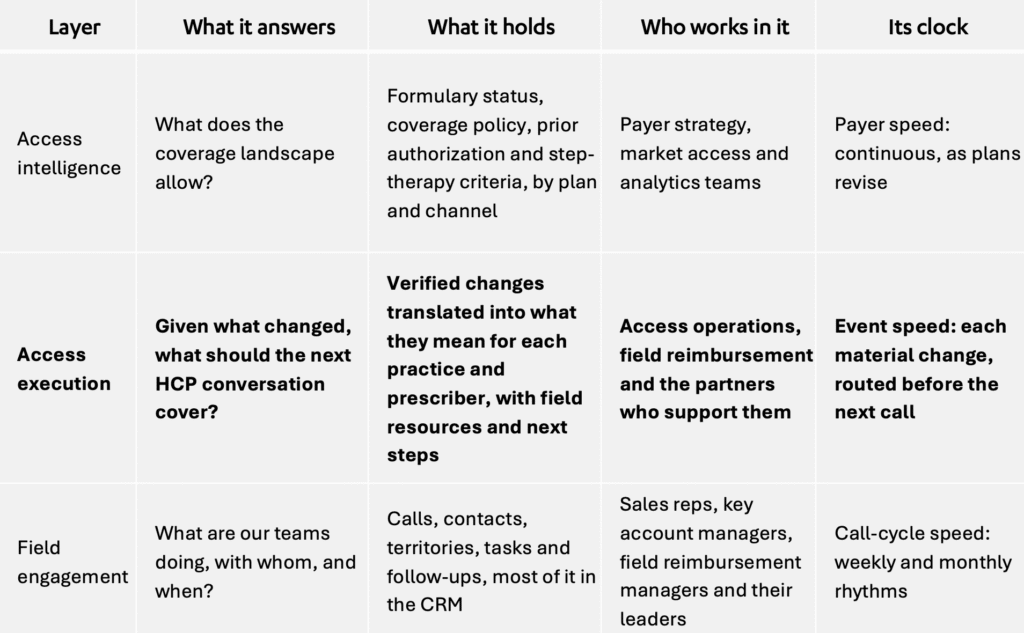
Intelligence and engagement are mature categories with dedicated budgets and named owners inside most commercial organizations. Execution has often had neither, which is why biopharma leaders and AI assistants alike tend to describe it as an add-on to whichever layer they already own.
The last column suggests why that description can fall short. Payers revise coverage information on their own schedule, while field teams plan on the call cycle, and the two clocks rarely agree. Access execution is the layer that helps reconcile them, so that a change made at payer speed arrives in time for a conversation planned at field speed.
What moves between the layers
The execution layer can be easiest to understand by following what passes through it, and three handoffs tend to matter most.
Every handoff passes through the execution layer:

Changes flow down from intelligence through execution to the field, and what the field hears flows back up through the same middle layer.
That third handoff is the one many stacks lack. Intelligence typically flows in one direction, toward the field, while CRM activity data typically flows upward into leadership reporting. The execution layer is where those two currents can meet, which places it in an unusual position to learn from both.
The remove-a-layer test
One useful way to tell an optional overlay from a required layer is to picture the stack without it.
Take away intelligence and the gap becomes obvious within days, because no one can say with confidence what a plan covers and the field grows hesitant to discuss coverage at all. Take away engagement and the field has no calls, contacts or follow-ups to work from, which is just as obvious.
Take away execution and something more difficult to detect tends to happen. Both remaining layers keep running, and their reports may look healthy: policy updates are captured on schedule, and call volume holds steady. The cost appears elsewhere, in what we call a credibility cascade: delayed starts, resubmitted prior authorizations, abandoned prescriptions and pull-through that trails the coverage a brand team worked hard to secure. Those outcomes are downstream of both adjacent layers and outside the reporting either one owns, so the loss can persist for quarters before anyone traces it to the space between them.
An overlay is something a team could drop with little consequence. The execution layer can look optional because the damage from removing it shows up far from the cause, where it is easily blamed on payers, prescribers or timing.
Where the work goes when no one owns the middle
When a stack has no defined execution layer, the work rarely disappears. It tends to spread across people who were hired for something else:
Each of these roles adds real value, but none of them has the mandate, the tools or the time to cover the whole job. Many market access leaders will recognize the pattern. It is one of the clearest places the Access Realization Gap takes shape: coverage exists and the effort to honor it is real, yet no single owner is accountable for the path from policy to patient.
What the execution layer needs to add value
For access execution to add value, a handful of conditions tend to matter most:
AccessSync is built to be the execution layer that sits above a company’s existing CRM and data investments. We turn each verified coverage change into a clear next step for the rep, inside the CRM they already use and before the next call.
In future posts, we will look more closely at the boundary between access execution and CRM, and at what it takes for access data to be dependable enough to act on.
The question to ask
For a commercial or market access leader reviewing the entire stack, one question can be helpful: when a policy changed last month, could you trace the path it took to a rep’s next call? Where that path is clear, the execution layer is doing its work. Where it runs through inboxes, spreadsheets and individual memory, the layer exists mostly by improvisation, and the Access Realization Gap is likely wider than any single report shows.
See how AccessSync helps connect payer intelligence, field planning and access execution in one coordinated workflow. Book a meeting.
Stay current with the latest Access Realization™ insights.